
Carpenter Bee Control
Serving Atlanta Metro | Columbus | Augusta | Savannah
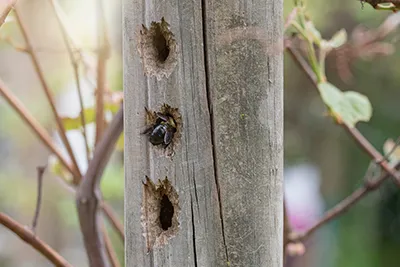 Carpenter bees are not aggressive and getting stung by one is extremely rare. However, they’re still a problem for their ability to cause damage and destruction to buildings and structures in Georgia. These wood-destroying insects are tough to eliminate without professional carpenter bee control.
Carpenter bees bore into wooden structures to lay their eggs. Their larvae and pupae consume wood as they develop and emerge as adults in the fall, ready to start the life cycle anew. Our professional carpenter bee control stops this destructive breeding behavior, ensuring that your home is protected.
Carpenter bee removal can be tricky, especially for DIYers, because, unlike many species of bees, there’s no single nest to target. Carpenter bees may spread out across your entire yard or property, and if you don’t eliminate all of them, they can keep coming back. That’s why you should trust the experienced carpenter bee exterminators at Active Pest Control. We understand how to solve your carpenter bee problem and ensure they don’t come back.
To schedule your carpenter bee control in Georgia or for a free estimate, give us a call today.
What’s the Difference Between Carpenter Bees and “Regular” Bees?
- Carpenter bees are solitary, often appearing alone or in small groups; regular bees live in large social colonies of thousands.
- Carpenter bees cause damage by boring into wood structures to create nests; regular bees often build nests in trees, holes in the ground, and crevices. They build wax combs in nests and various places.
- Carpenter bees hover aggressively but rarely sting; regular bees are not aggressive but will sting when threatened
- Carpenter bees are poor pollinators; regular bees are essential for pollination
For more information about “regular bees,” check out our bee control page.
What Do Carpenter Bees Look Like?
- Carpenter bees are large and robust, while regular bees are much smaller and slender.
- A carpenter bee has a shiny, hairless black abdomen. Regular bees are fuzzy all over.
- Both have fuzzy thoraxes, but a carpenter bee’s fuzz is often a brighter yellow.
- Carpenter bees have a metallic blue-green or purple sheen; regular bees have duller gold and black stripes.
Why Choose Active Pest Control for Carpenter Bee Control?
We understand you have many options for carpenter bee control in Georgia. When you choose Active Pest Control, you’re choosing to work with a team that will go the extra mile so your home is protected from carpenter bees and the costly damage they cause.
Here’s how we provide carpenter bee extermination services you can count on:
- Fast local service: We prioritize rapid response times from local carpenter bee control specialists who can halt the destruction before it advances. Our team understands that every day of delay means more damage and repair costs.
- Expert exterminators: We train our technicians to understand carpenter bee biology and control techniques specific to our region, including how to identify active boring sites, seasonal patterns, and the difference between territorial behavior and nesting activity. We know when and where these wood-destroying insects are most active.
- Clear communication: We’ll provide a detailed assessment of the carpenter bee activity and our treatment steps. Furthermore, we’ll empower you with highly effective strategies for preventing future wood boring and structural damage. Have any lingering concerns? Don’t hesitate to reach out – we’re always here to help.
- Targeted carpenter bee treatments: We tailor our carpenter bee control strategies to your property needs. After assessing your situation, we’ll develop a plan focusing on active boring sites, vulnerable wood surfaces, and potential nesting areas. Our approach targets current infestations and prevents future generations from returning to the same locations.
- Online account management: Enjoy effortless appointment scheduling, payment management, and monitoring service progress with our streamlined online system. Carpenter bee control has never been easier!
The Professional Carpenter Bee Control Process – How Does It Work?
When you call Active Pest Control, it’s because carpenter bees are literally boring holes into your home, threatening your property value. Here’s how we provide rapid elimination and long-term protection from these destructive wood-boring insects:
- Inspection: We’ll meticulously inspect your property to identify active boring sites and areas most vulnerable to carpenter bee damage. We’re searching for perfectly round entrance holes, characteristic sawdust piles, yellowish staining from bee excrement, and the distinctive hovering behavior of territorial males. This comprehensive assessment helps us understand the extent of the current infestation and provide the best possible solutions.
- State-of-the-art treatment: Our precision treatments eliminate carpenter bees and put a stop to the destruction. We treat active galleries directly, eliminate emerging adults, and apply protective barriers to vulnerable areas, giving you immediate and long-lasting protection against structural damage.
- Long-term prevention: Our long-term strategy focuses on keeping carpenter bees from returning. We provide specific, actionable recommendations, structural modifications, and maintenance practices that make your home less attractive to these persistent pests, so you can protect your investment and avoid costly repairs year after year.
FAQs on Carpenter Bees and Carpenter Bee Removal
As a leader in pest control in Georgia, we’ve eliminated countless carpenter bee infestations. We’re proud to help our neighbors protect their homes from the structural damage and repair costs these wood-boring insects can cause.
Over the years, we’ve gained extensive insights into carpenter bees, which we’re pleased to be able to share with you. From identifying carpenter bees to recognizing the long-term structural risks of untreated infestations, your answers are here.
And if you don’t find what you need, don’t hesitate to reach out!


