
Snake Trapping & Removal
Serving Atlanta Metro | Columbus | Augusta | Savannah
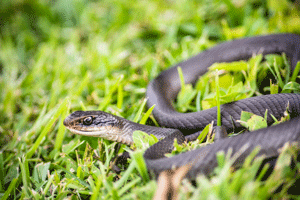
Nothing ruins your time outdoors like finding a snake slithering through your garden, especially if you aren’t sure whether or not it’s dangerous. Dealing with snakes can be stressful and potentially harmful depending on the species, but don’t worry — you don’t have to put your health and safety at risk. Active Pest Control proudly offers fast and efficient snake removal services in Georgia.
From removing individual snakes to long-term snake exclusion, Active Pest Control is here to help. Call us now for expert snake trapping and removal service in Georgia.
Common Snakes in Georgia
With relatively warm year-round weather in Georgia, snakes are a common problem here no matter the season. These are the species you’re most likely to find in your backyard:
Non-Venomous Snakes
- Banded water snake: Has a stout body with distinctive dark crossbands on a background color that can range from brown to reddish, and its belly is marked with black and white or yellowish patterns.
- Brown snake: Small and slender, usually brown or gray with a lighter, often pinkish belly, and a series of dark spots or streaks running down its back.
- Common garter snake: Thin and has three yellow or white stripes running lengthwise down its body, which can range in color from green to brown. Most have a pattern of dark spots between the stripes.
- Common water snake: Thick body with a background color of gray to brown, marked with dark crossbands or blotches, and its belly is often white, yellow, or gray with dark crescent-shaped spots.
- Eastern rat snake (black rat snake): Large, slender snake with a shiny black body and a lighter belly. They are expert climbers commonly found in attics, crawlspaces, and wall voids hunting for rodents.
- Pine snake: Large, robust snake with a cream to light gray base color, covered with black, brown, or reddish blotches that become more pronounced towards the tail, and a distinctly pointed snout.
Venomous Snakes
- Canebrake rattlesnake: Heavy, thick body with a base color of pinkish-tan to gray, overlaid with dark chevron-shaped crossbands and a distinctive rusty stripe running down its back.
- Copperhead: Recognized by its tan or light brown body overlaid with dark brown, hourglass-shaped crossbands. This is the most frequently encountered venomous snake in Georgia.
- Cottonmouth: Often found in environments near water, easily mistaken for the harmless banded water snake.
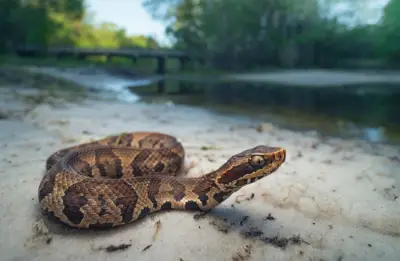
Banded Water Snake vs. Venomous Cottonmouth: How to Tell the Difference
Harmless Banded Water Snakes and venomous Cottonmouths (Water Moccasins) share similar dark patterns and aquatic habitats, making them easy to confuse. Use these key visual traits to identify them safely from a distance:
Feature | Cottonmouth (Venomous) | Banded Water Snake (Non-Venomous) |
Swimming Profile | Floats high with entire body visible | Swims mostly submerged with only head exposed |
Head Shape | Blocky, triangular head with a distinct neck | Slender, oval head tapering smoothly into body |
Pupils | Vertical, cat-like slits | Completely round |
Defensive Stance | Coils and gapes to show white mouth interior | Retreats quickly into the water |
Need an Estimate for Snake Control?
Our Snake Removal Process
Effective long-term snake removal is a multi-step process, from removing the active wildlife in your home to proactive exclusion to prevent future issues. Here is how our technicians approach snake problems in homes in Georgia:
- Property Inspection: We inspect areas with snake activity for hiding places, entry points, and potential food sources.
- Snake Trapping and Removal: We use professional methods to properly trap and remove snakes from your property.
- Identify Potential Entry Points: We look for gaps and openings that may allow snakes to enter your home or business.
- Exclusion and Prevention Recommendations: We recommend sealing entry points and reducing conditions that attract snakes.
- Service Documentation and Prevention Tips: We document the service and provide tips to help prevent future snake problems.
Georgia Snake Trapping & Removal FAQs


